
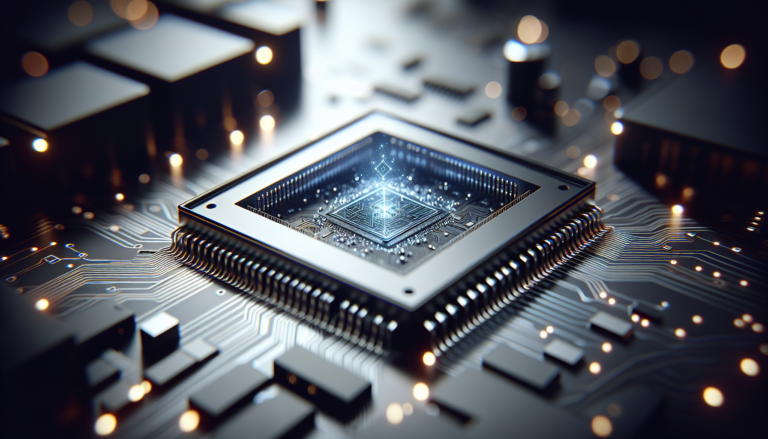
In a world increasingly shaped by artificial intelligence, from the personalized recommendations on our streaming services to the advanced safety features in our cars, there’s a fundamental, often unseen, force enabling it all: AI chips.These specialized processors are not just components; they are the silent architects of the modern AI revolution, quietly powering the intelligence that infiltrates nearly every aspect of our digital lives. They are the unsung heroes that transform complex algorithms into lightning-fast decisions, making our devices smarter, more efficient, and incredibly intuitive.
The pervasive nature of AI in today’s technology means that every interaction, every intelligent system, relies on a sophisticated hardware backbone. This blog delves into the fascinating world of AI chips, exploring what they are, why they’re so crucial, the diverse forms they take, and the profound impact they have on innovation across industries.
What Exactly Are AI Chips? The Brains Behind the Intelligence
At its core, artificial intelligence, particularly machine learning and deep learning, involves colossal amounts of data processing, pattern recognition, and complex mathematical computations. Traditional Central Processing Units (CPUs), while versatile, are designed for sequential processing, making them less efficient for the highly parallelizable workloads inherent in AI. This is where AI chips come in.
AI chips are specialized semiconductor devices engineered to accelerate AI and machine learning tasks. Unlike general-purpose CPUs, they boast architectures optimized for parallel processing, high throughput, and energy efficiency when handling specific AI operations like neural network inference and training. This specialization allows them to perform AI computations significantly faster and with less power consumption than their general-purpose counterparts. They are, in essence, purpose-built brains for artificial intelligence.
The Diverse Landscape of AI Processors
The field of AI hardware is rapidly evolving, giving rise to a variety of specialized chips, each with its unique strengths and applications. Understanding these different types is key to appreciating the breadth of the “silent revolution.”
GPUs (Graphics Processing Units): The Pioneers of Parallelism
Initially designed for rendering graphics in video games, GPUs from companies like NVIDIA quickly became the workhorses for early AI development. Their architecture, comprising thousands of smaller cores, excels at performing multiple calculations simultaneously—a perfect match for the parallel nature of neural network training. Today, high-performance GPUs remain central to training large-scale AI models in data centers and cloud environments.
TPUs (Tensor Processing Units): Google’s Custom Silicon
Recognizing the need for even greater efficiency for their own TensorFlow framework and AI workloads, Google developed the Tensor Processing Unit (TPU). TPUs are Application-Specific Integrated Circuits (ASICs) custom-built to accelerate matrix multiplication operations, a common task in deep learning. They are highly optimized for both training and inference, particularly within Google’s cloud infrastructure and for specific applications like search and translation.
NPUs (Neural Processing Units): AI at the Edge
As AI moves from the cloud to our pockets, Neural Processing Units (NPUs) are becoming indispensable. These chips are specifically designed for efficient AI inference on edge devices like smartphones, smart speakers, drones, and IoT sensors. NPUs prioritize energy efficiency and low latency, enabling features like real-time facial recognition, natural language processing, and enhanced computational photography directly on the device, without needing to send data to the cloud. Apple’s Neural Engine and Qualcomm’s AI Engine are prime examples.
ASICs (Application-Specific Integrated Circuits) & FPGAs (Field-Programmable Gate Arrays): Customization and Flexibility
Beyond GPUs, TPUs, and NPUs, the landscape includes other specialized hardware. ASICs are highly customized chips designed for a very specific task, offering the ultimate in performance and power efficiency for that particular application. FPGAs, on the other hand, offer more flexibility; their logic can be reprogrammed even after manufacturing, making them suitable for scenarios where algorithms might evolve or specific hardware acceleration is needed for niche applications.
Driving Innovation Across Industries
The impact of AI chips reverberates across virtually every sector, fundamentally changing how industries operate and how we interact with technology.
Edge AI and Consumer Devices
Our smartphones are mini-supercomputers thanks to integrated AI chips. Features like real-time language translation, advanced photography modes (e.g., portrait mode, night mode), voice assistants (Siri, Google Assistant, Alexa), and enhanced security (facial and fingerprint recognition) are all powered by NPUs performing billions of operations per second locally. This on-device processing enhances privacy, reduces latency, and often works offline.
Data Centers and Cloud Computing
The backbone of modern cloud services and large-scale AI research, data centers house vast arrays of high-performance GPUs and TPUs. These chips enable the training of massive foundation models, power complex simulations, and serve AI-driven applications to millions of users globally. The global AI chip market is projected to reach over $100 billion by 2026, driven significantly by data center and cloud adoption.
Autonomous Systems
Self-driving cars, drones, and advanced robotics rely heavily on AI chips to process torrents of sensor data (Lidar, radar, cameras) in real-time. These chips enable object detection, path planning, decision-making, and obstacle avoidance, all crucial for safe and effective autonomous operation. The demand for robust, energy-efficient AI hardware in this sector is immense.
Healthcare and Scientific Research
In healthcare, AI chips accelerate drug discovery by simulating molecular interactions, enhance diagnostic imaging by analyzing medical scans with unprecedented accuracy, and power personalized medicine by processing genomic data. Scientists leverage them for complex simulations in physics, climate modeling, and material science, drastically cutting down research timelines.
Enterprise and Industrial IoT
From optimizing supply chains with predictive analytics to powering smart factories with real-time anomaly detection, AI chips are revolutionizing enterprise operations. In industrial IoT, they enable edge devices to analyze sensor data for predictive maintenance, improving efficiency and reducing downtime without constant communication with central servers.
The Unseen Impact: How AI Chips Shape Our Daily Lives
The “silent revolution” moniker is apt because most users are unaware of the underlying hardware enabling the AI features they use daily. When your smart doorbell distinguishes between a person and a package, an AI chip is working. When your noise-canceling headphones adapt to your environment, an AI chip is analyzing soundscapes. When a search engine provides incredibly relevant results, it’s often powered by vast AI models running on specialized hardware. These chips are making our interactions with technology more intuitive, our lives more convenient, and our devices more capable without ever demanding our explicit attention.
Challenges and the Road Ahead
Despite their immense potential, AI chips face several challenges. Power consumption and heat dissipation are critical concerns, especially for high-performance data center chips and compact edge devices. Manufacturing advanced semiconductors is incredibly complex and costly, leading to geopolitical implications and supply chain vulnerabilities. Furthermore, optimizing software to fully leverage the unique architectures of diverse AI chips remains an ongoing challenge for developers.
Looking ahead, the future of AI chips is poised for even greater innovation. Research into neuromorphic computing aims to mimic the brain’s structure and function for ultra-efficient, event-driven processing. Quantum AI chips promise exponential leaps in computational power for specific problems. We can expect continued specialization, with more domain-specific architectures emerging, and a relentless pursuit of greater energy efficiency and smaller form factors. The democratization of AI will also depend on more accessible and affordable AI hardware.
Conclusion
AI chips are more than just silicon and circuits; they are the fundamental enablers of the artificial intelligence era. From empowering the pocket-sized supercomputers we carry daily to accelerating breakthroughs in medicine and driving the next generation of autonomous systems, their impact is profound and continuously expanding. While they may operate silently, their revolution is anything but quiet, reshaping industries, transforming our daily lives, and paving the way for a future where intelligence is not just artificial, but ubiquitous.
As AI continues its rapid evolution, the innovation in chip design will remain a critical frontier, pushing the boundaries of what’s possible and ensuring that the silent revolution continues to echo through every corner of our technologically advanced world. What role will you play in this intelligent future? Perhaps it’s time to explore how AI-powered solutions, underpinned by these incredible chips, can transform your own ventures or deepen your understanding of the technology shaping tomorrow.